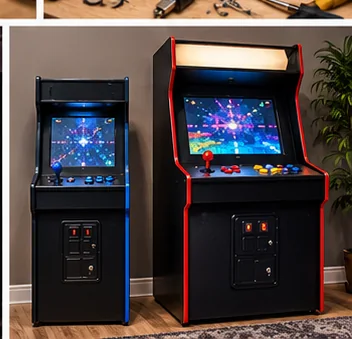
The short answer
A cabinet is worth it if you want a piece of furniture that is also a game machine: real controls, a built-in screen, a presence in the room and games that feel like an event. A plug-in retro console is worth it if you want a lot of classic games with the least space, effort and commitment. For most people the console is the better first step, and the cabinet is the better second one once you know you play enough.
Neither is wrong. The question is how much space, setup and money you want to trade for feel.
Cabinet versus console, side by side
This table compares the two types in general terms. Individual products vary.
| Factor | Arcade cabinet | Plug-in retro console |
|---|---|---|
| Space | Floor or table space; needs a clear spot and a route to get there | Fits a shelf or drawer |
| Setup | Assembly or delivery, plus power and sometimes software setup | Plug into a TV and power |
| Controls | Arcade-style stick and buttons, often built in | Small pads or sticks; some accept extra controllers |
| Screen | Usually built in | Uses your TV |
| Game library | Fixed list on many models, larger on some; licensing varies | Pre-loaded list; varies by model |
| Guests | Great for standing and sharing | Works, but depends on controllers |
| Upkeep | Cleaning, parts, sometimes repairs | Minimal |
| Moving it | Heavy and awkward | Easy |
| Resale | Some hold interest; shipping is hard | Low value, easy to ship |
Check the actual model, because both categories include very different products. Read the listing for the game list, the controls, the connections and the return terms.
What a cabinet gives you that a console does not
The cabinet's advantage is physical. Arcade sticks and buttons suit the games they were made for, a built-in screen means no TV hunting, and the whole thing becomes a destination. Friends gather around it. It is also a hobby: you can upgrade parts, swap controls or display, and learn how it works.
The trade is commitment. A cabinet needs a spot, a route through the house and some care, and many cabinets come with a fixed game list. If you buy one for the wrong reasons, you may end up with a heavy object you rarely use. The first-day setup checks show what the first week is like.
What a console does better
Plug-in consoles win on convenience. They are cheap to try, tiny, and easy to hide or take along. If your main goal is to revisit a few dozen childhood games on the living room TV, a console may be all you need. They also let you test your interest before committing floor space. If you stop playing, it costs little to put one in a drawer.
The weaknesses are feel and depth. Small pads and short cables suit one player better than a group, game lists can be modest or repetitive, and you rely on the TV and its input lag. Some systems allow extra controllers or accessories, and arcade-style sticks can help with the feel. Look for the connections and controller options in the listing.
The middle options
You do not have to choose between a full cabinet and a tiny box. Bartop and countercade machines sit on a table with arcade controls and a built-in screen, and the bartop and countercade guide covers them. Full cabinets differ too: the Arcade1Up vs AtGames comparison explains how dedicated cabinets and larger platforms differ. The small space home arcade guide is useful if floor space is the question, and the guide to choosing a cabinet walks through the full decision.
The total cost picture
Compare what you pay in total, not only the sticker figure. A cabinet may need delivery, a clear path, extra controls or a riser, and a console may need a spare controller, cables or an adapter for your TV. Space has a cost too: a cabinet that blocks a walkway or sits in a cold garage costs you in annoyance and wear.
Think about time as well. A cabinet that takes an afternoon to assemble and a weekend to tune is a project, and some people enjoy that. A console that works in five minutes suits someone who just wants to play. The setup cost calculator helps you add up the extras before you commit.
Who should pick which
- Choose a console if you want a quick nostalgia fix, have little space, are buying for a child who may lose interest, or want to try before you commit.
- Choose a cabinet if you have the space, care about the feel of real controls, like hosting friends, or enjoy tinkering.
- Choose a bartop if you want the cabinet feel in a smaller footprint.
- Wait if you are unsure; the first purchase can be a console, and a cabinet can come later.
Whichever you choose, read the return terms before you buy, check the listing for what is included, and be careful with any listing that promises a huge game library without saying how the games are licensed. If you are buying for someone else, gift ideas by type of player helps match the choice to the person.
Questions to ask before you buy
- Where will it live, and can I get it there?
- How many people usually play at once?
- Do I want to tinker, or just play?
- What does the listing say about the game list, controls and returns?
- Would a cheaper first step tell me whether I will use it?
If you answer honestly, the choice is usually clear. People who want to host friends and have the room tend to be happier with a cabinet, while people with limited space or uncertain interest are better served by starting small. Either way, keep the packaging until you know you are keeping it.
Frequently asked questions
Is an arcade cabinet better than a retro console?
It depends on what you want. A cabinet offers real controls and presence, while a console offers convenience, low space and low commitment.
Do I need space for an arcade cabinet?
Yes. You need floor or table space, a route to get it there, and access to power.
Are retro consoles good for multiple players?
They can be, but small controllers and cables limit the experience. Check whether the model supports extra controllers.
What about a bartop machine?
A bartop gives you arcade controls and a built-in screen in a smaller footprint.
Should I check the game list before buying?
Yes. Read what is included, how it is licensed and what the return terms are.
Affiliate disclosure: HomeArcadeGuide.com may earn from qualifying purchases through Amazon Associates and eBay Partner Network at no extra cost to you. Manufacturer links in the source section are research references, not tracked endorsements.