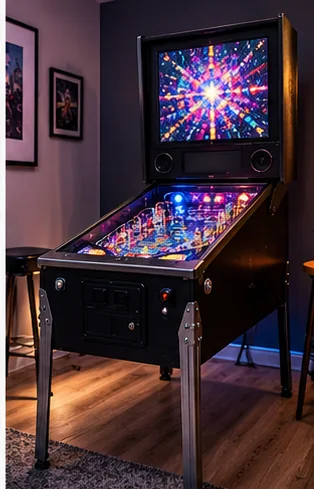
Products and configurations to compare
Legends Pinball Micro HD
AtGames currently lists a 15.6-inch 1080p/60 playfield, 8-inch backglass, 50 built-in tables and a 24.27-pound cabinet.
Best when: you want real cabinet controls and a two-screen layout without giving up much floor space
Watch for: 15.6-inch playfield is intentionally compact
Legends Pinball 4KP
The current 4KP family uses a 32-inch playfield that supports resolutions up to 4K.
Best when: you want a 32-inch playfield capable of up to 4K and a turnkey furniture-scale cabinet
Watch for: current packages start around the high-$1,000s and not every table renders at full 4K
Custom PC virtual pinball cabinet
Custom builds can optimize display refresh, input latency, SSF/solenoids and multi-screen layout around your priorities.
Best when: you want high-refresh PC hardware, custom feedback and a large playfield
Watch for: significantly more setup, software maintenance and wiring
Playfield size changes the illusion
Pinball benefits from physical scale. A 15.6-inch Micro is fun and convincing as a compact machine; a 32-inch or 40-plus-inch playfield creates a much stronger sense that the ball is moving across a real table.
Resolution is not the same as responsiveness
A 4K playfield can look beautiful while poor frame pacing makes flippers feel disconnected. For DIY builds, high refresh and low input latency often matter more to gameplay than pushing every pixel.
Backglass and DMD layout matters
A dedicated backglass turns a flat display into a cabinet experience. Three-screen custom builds can add a dedicated DMD while turnkey machines integrate their own layout.
Feedback upgrades have diminishing returns
Basic haptics add impact. Surround-sound feedback and contactors can localize mechanical events. Solenoids create stronger physical sensation but add noise, heat, wiring and maintenance.
Table ecosystems are not interchangeable
Verify which tables, packs and external modes are supported by the exact hardware generation. AtGames HD and 4K families have distinct content compatibility.
Virtual pinball is a display-and-latency purchase as much as a game purchase
A virtual table has to convince your hands and eyes that a digital ball is responding instantly. Playfield refresh, software frame pacing, flipper input latency, haptics and cabinet audio matter more than raw table count. A huge game library does not rescue mushy flippers or a laggy display.
Physical feedback is the second layer. Basic haptics give a cabinet some life; more elaborate speaker/solenoid systems can make bumpers and flippers feel localized. That feedback is one reason a full-size virtual pinball cabinet can feel dramatically different from a large monitor laid flat on a desk.
Real pinball and virtual pinball are not substitutes in every sense
A real machine gives you actual coils, switches, mechanical tolerances and a unique physical playfield. It also needs cleaning, leveling, rubbers, switches, occasional parts and much more floor space per title. Virtual pinball gives you hundreds of tables in one footprint with far less mechanical maintenance. Buy based on whether the maintenance is part of the hobby or an obstacle to the games.
Before checkout
- Measure final cabinet footprint and player standing space
- Measure the entire delivery route before ordering
- Confirm game list, control layout and number of players
- Check screen size and viewing angle from normal stance/seating
- Confirm Wi-Fi/Ethernet needs and whether online features are optional
- Price stools, risers, mats and surge protection with the machine
- Check warranty, freight damage and return terms
- Confirm replacement controls or parts are realistically obtainable
- Plan ventilation and service access
- Use only game/software content you have the rights to run
Installed cost: the part listings do not show
Budget freight or local pickup, stools or seating, floor protection, surge protection, network access, extension of an existing wired network where appropriate, and an initial parts reserve. If a machine requires permanent electrical work, treat that as room infrastructure rather than hiding it inside the cabinet price. A collection that arrives under budget but has no comfortable place to stand or sit is not actually under budget.
Measure the route with packaging in mind when a machine ships assembled or partly assembled. Door width is only one constraint; stair turns, ceiling height, railings, elevators and the ability to rotate a long cabinet matter. HomeArcadeGuide's doorway and shipping planners exist to catch those mistakes before freight arrives.
How to evaluate the purchase in the first week
Play the games and controls you bought it for, not only the easiest title on the menu. Test every direction/button, both players, audio at quiet and loud levels, network reconnect after power-off, display uniformity and cabinet wobble. If it is a virtual or software-driven platform, update only after confirming the current machine works and documenting its starting state.
Keep the carton and packing material until the return window and freight-damage inspection are safely behind you. Large arcade products are unusually expensive to return, and original packaging can matter if a display or control panel needs to travel for service.
Frequently asked questions
Is the Legends Pinball Micro really pinball-sized?
It is a compact tabletop/furniture hybrid, not a full-size cabinet; the playfield is 15.6 inches.
How big is the Legends 4KP playfield?
AtGames lists a 32-inch playfield supporting up to 4K resolution.
Does every 4KP table run in 4K?
No. AtGames explicitly notes that not every table runs the playfield at full 4K.
Is custom virtual pinball better?
It can be for refresh rate, latency and feedback, but it requires much more setup and maintenance.
Primary/current sources
Affiliate disclosure: HomeArcadeGuide.com may earn from qualifying purchases through Amazon Associates and eBay Partner Network at no extra cost to you. Manufacturer links in the source section are research references, not tracked endorsements.