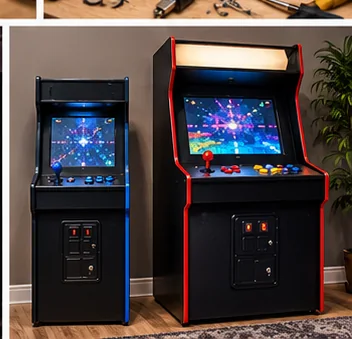
Count the players who actually play at once
Most nights, two people are playing and the rest are watching or waiting. A two-player cabinet is enough for that, and it is cheaper and smaller than a four-player one. A four-player cabinet earns its space only if you regularly have three or four people who want to play the same game at the same time.
Think about the games, too. Many classic arcade games alternate turns between players, so a second panel for players three and four adds nothing. Games built for simultaneous play, such as co-op brawlers and some shooters, are where extra players matter. Check the game list for how many players each title supports, not just what the cabinet's panel offers.
Then think about your guests. A group of adults who like to take turns is different from a house of kids who all want a controller. If you host often, a four-player machine may be worth it. If game night is occasional, a two-player cabinet plus a rotation habit works fine.
How panel width changes the answer
A control panel has a fixed width, and every extra player has to fit in it. Two players fit comfortably on most panels. Four players share a wider panel, and elbows and stances start to overlap. A wider panel also means a wider cabinet, which affects doorways, walls and the number of machines you can fit.
Look at the spacing between players and the position of the buttons in photos and in the spec sheet. Cramped layouts can mean one player blocks another's screen view. Compare how the players stand: side by side, or two on each side of a table as on a cocktail machine. The cocktail arcade table guide explains how seating changes the two-player experience, since players face each other instead of the screen.
Measure the final footprint before you buy. The room planner helps you check whether a wide cabinet leaves room to stand behind and beside it.
Seating, sightlines and standing room
Four people can crowd a single screen. The players at the ends see the picture at a sharper angle, and a small screen shrinks quickly at a distance. If the screen is small, a four-player layout may leave the outer players squinting. Standing is the norm for upright cabinets, but stools help for long sessions, and the arcade stools and seating guide explains height and stability.
Think about who will watch. A game night often has more spectators than players, and a place to sit behind the players makes the evening more social. Leave a path behind the cabinet for people to move without bumping the players.
As an eBay Partner, I may be compensated if you make a purchase.
Alternatives to a four-player cabinet
You can solve the same problem in several ways. Two cabinets side by side give you four players with separate screens, which avoids the crowded-panel problem. A cocktail table gives two or four seats around one screen for games designed for it. A countertop machine is cheap to add and can sit on a table for casual rounds, as the bartop and countercade guide explains.
Another option is a platform cabinet that supports extra controllers. The Arcade1Up vs AtGames Legends Ultimate comparison explains how a flexible platform handles different control layouts. Check whether it supports extra players through the panel, plug-in controllers or both.
Which setup fits your group
Use this as a rough guide.
| Your game nights | Likely fit | Watch for |
|---|---|---|
| Two players, occasional guests | Two-player cabinet | Enough game variety for turn-taking |
| Family with kids who share | Two-player cabinet plus a rotation rule, or two machines | Reach and height for smaller players |
| Regular groups of three or four | Four-player cabinet or two cabinets | Panel width, doorway, floor space |
| Competitive head-to-head players | Two-player cabinet with a quality panel | Control feel, not player count |
| Social hosts with many spectators | Cocktail table or a mixed room | Seating, standing room and traffic flow |
For more on planning a space for family play, see the family-friendly home arcade guide.
What to confirm before you buy
Whatever you choose, confirm four facts on the listing or the maker's page: how many players the controls support, how many of the included games support that many at once, the cabinet's external width and the screen size. If a listing is vague on any of them, ask the seller. A cabinet that promises four players but has only two sets of controls is not what it seems.
If you are still deciding what kind of machine to start with, the best home arcade cabinet guide sorts dedicated and flexible cabinets. For ideas on who gets what at the holidays, the gift ideas by type of player may help.
Frequently asked questions
Do I need a four-player arcade cabinet?
Only if three or four people regularly play together. For most households, two players and a rotation habit work well.
Do all arcade games support four players?
No. Many classic games alternate turns, and some support two at once. Check the player count for each title on the game list.
Is a four-player cabinet much bigger?
It has a wider panel and usually a wider cabinet. Check the external width and your doorway and wall space before buying.
Can two cabinets replace a four-player machine?
Yes. Two machines give four players separate screens, though they take more floor space and cost.
What about a cocktail table?
A cocktail table suits games built for it and seats players across from each other. It is a different experience from standing at an upright.
Affiliate disclosure: HomeArcadeGuide.com may earn from qualifying purchases through Amazon Associates and eBay Partner Network at no extra cost to you. Manufacturer links in the source section are research references, not tracked endorsements.