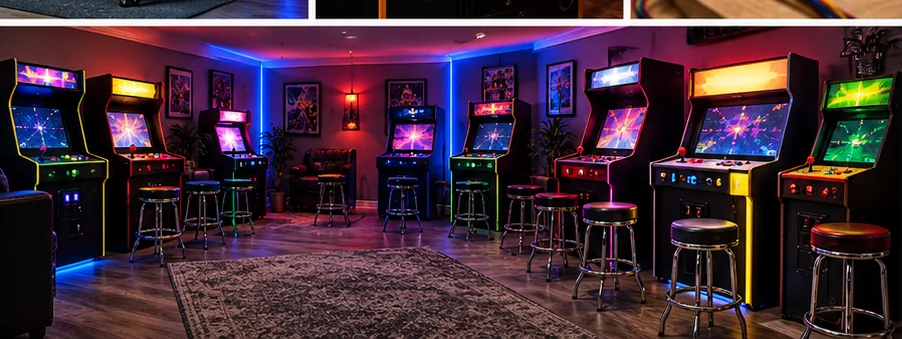
Products and configurations to compare
Flexible upright platform
This handles broad classics and specialty controls while leaving other machines free to be distinctive.
Best when: you want the broadest game/control coverage from one footprint
Watch for: connected platform is less visually iconic than a title cabinet
Dedicated licensed upright
Choose the title that people in your household will actually walk up and play.
Best when: you want recognizable cabinet art and game-specific control feel
Watch for: narrower game library
Immersive category machine
A racer or pinball changes body position, controls and social use, which makes a small collection feel much larger.
Best when: you want pinball or driving to stop the room feeling repetitive
Watch for: immersion machines need more floor/depth than their cabinet footprint suggests
Budget by category, not machine count
Put roughly half the machine budget into the anchor and immersive machine, then use a dedicated upright/compact machine for character.
Leave a room-infrastructure reserve
HomeArcadeGuide's existing setup-cost calculator already treats delivery, electrical, flooring, lighting, seating, parts and networking as separate budget lines. Keep them separate in real life too.
Mix standing and seated play
A room with only uprights makes everyone stand in one posture. A cocktail table, stool station, pinball or racer changes pace and makes the collection more social.
Buy one machine at a time when possible
The first cabinet teaches you how much clearance, noise and power you actually need. Let that inform the second purchase instead of pre-ordering the whole room.
Used machines stretch budget but increase inspection risk
A clean used commercial cabinet or virtual pinball machine can add a lot of value, but transport and repair reserve should be larger than with a new consumer cabinet.
The room is the largest cabinet in the arcade
Circulation space, service access and sight lines determine whether a collection feels like an arcade or a storage locker. Leave room to stand at controls without blocking the next machine, pull a cabinet away from the wall for service, open pinball coin doors/backboxes and move stools out of the traffic lane.
The delivery route matters before the floor plan. Measure the narrowest doorway, stairs, turns and elevator dimensions, not just the final room. HomeArcadeGuide already has doorway, room and shipping planning tools for this exact reason.
Electrical planning should follow actual nameplates
Consumer LCD cabinets often draw modest power individually, but a room of machines plus lighting, TVs, mini-fridges, amplifiers and simulators can become a significant continuous load. Estimate the machines you plan to run together, leave headroom and have fixed circuit work handled appropriately. Avoid building the room around daisy-chained power strips and extension cords.
Before checkout
- Measure final cabinet footprint and player standing space
- Measure the entire delivery route before ordering
- Confirm game list, control layout and number of players
- Check screen size and viewing angle from normal stance/seating
- Confirm Wi-Fi/Ethernet needs and whether online features are optional
- Price stools, risers, mats and surge protection with the machine
- Check warranty, freight damage and return terms
- Confirm replacement controls or parts are realistically obtainable
- Plan ventilation and service access
- Use only game/software content you have the rights to run
Installed cost: the part listings do not show
Budget freight or local pickup, stools or seating, floor protection, surge protection, network access, extension of an existing wired network where appropriate, and an initial parts reserve. If a machine requires permanent electrical work, treat that as room infrastructure rather than hiding it inside the cabinet price. A collection that arrives under budget but has no comfortable place to stand or sit is not actually under budget.
Measure the route with packaging in mind when a machine ships assembled or partly assembled. Door width is only one constraint; stair turns, ceiling height, railings, elevators and the ability to rotate a long cabinet matter. HomeArcadeGuide's doorway and shipping planners exist to catch those mistakes before freight arrives.
How to evaluate the purchase in the first week
Play the games and controls you bought it for, not only the easiest title on the menu. Test every direction/button, both players, audio at quiet and loud levels, network reconnect after power-off, display uniformity and cabinet wobble. If it is a virtual or software-driven platform, update only after confirming the current machine works and documenting its starting state.
Keep the carton and packing material until the return window and freight-damage inspection are safely behind you. Large arcade products are unusually expensive to return, and original packaging can matter if a display or control panel needs to travel for service.
Frequently asked questions
Can $5,000 build a good home arcade?
Yes. The key is mixing play styles and reserving money for room infrastructure rather than buying only machines.
How much should I reserve for non-machine costs?
Roughly 15–25% is a useful planning range, depending on freight/electrical/flooring needs.
How many machines fit in a typical room?
Use actual dimensions plus player/service clearance; the room planner is better than a generic machine count.
Should I buy all machines at once?
Usually no. One machine reveals how the room actually behaves and can prevent expensive layout mistakes.
Primary/current sources
- HomeArcadeGuide — current homepage and planning philosophy
- HomeArcadeGuide — planning tools
- AtGames — Legends Ultimate CE-HD current specs
- Arcade1Up — current 2026 lineup
Affiliate disclosure: HomeArcadeGuide.com may earn from qualifying purchases through Amazon Associates and eBay Partner Network at no extra cost to you. Manufacturer links in the source section are research references, not tracked endorsements.